AI infrastructure is priced off yesterday’s earnings instead of tomorrow’s agentic workflows. Signed demand, construction lags, and invisible P&L gains explain why this ‘bubble’ is still under built.
This is not a bubble but the creation of a new economy where ‘super intelligence‘ will be available on tap.
It’s fascinating how quickly we forget the mechanics of infrastructure cycles. Every time we build a technology that fundamentally rewires the global economy, whether it’s the railroads in the 1880s, the electrical grid in the 1920s, or the internet in the 1990s, we hit this exact moment. The capex spikes, the revenue recognition lags slightly behind, and the market screams “bubble”!
We are currently standing in that gap.
The sell-off following Oracle’s earnings miss this week fits the historical script perfectly. The market sees a missed quarterly revenue target and assumes demand is evaporating. But if you look past the headlines and into the P&L statements of the companies actually building the future, the data tells a different story.
This is not a bubble but the creation of a new economy where ‘super intelligence‘ will be available on tap.
Would you bet against this?
Cloud Growth Is AI Growth
The most common bear case is that “no one is making money except Nvidia.”
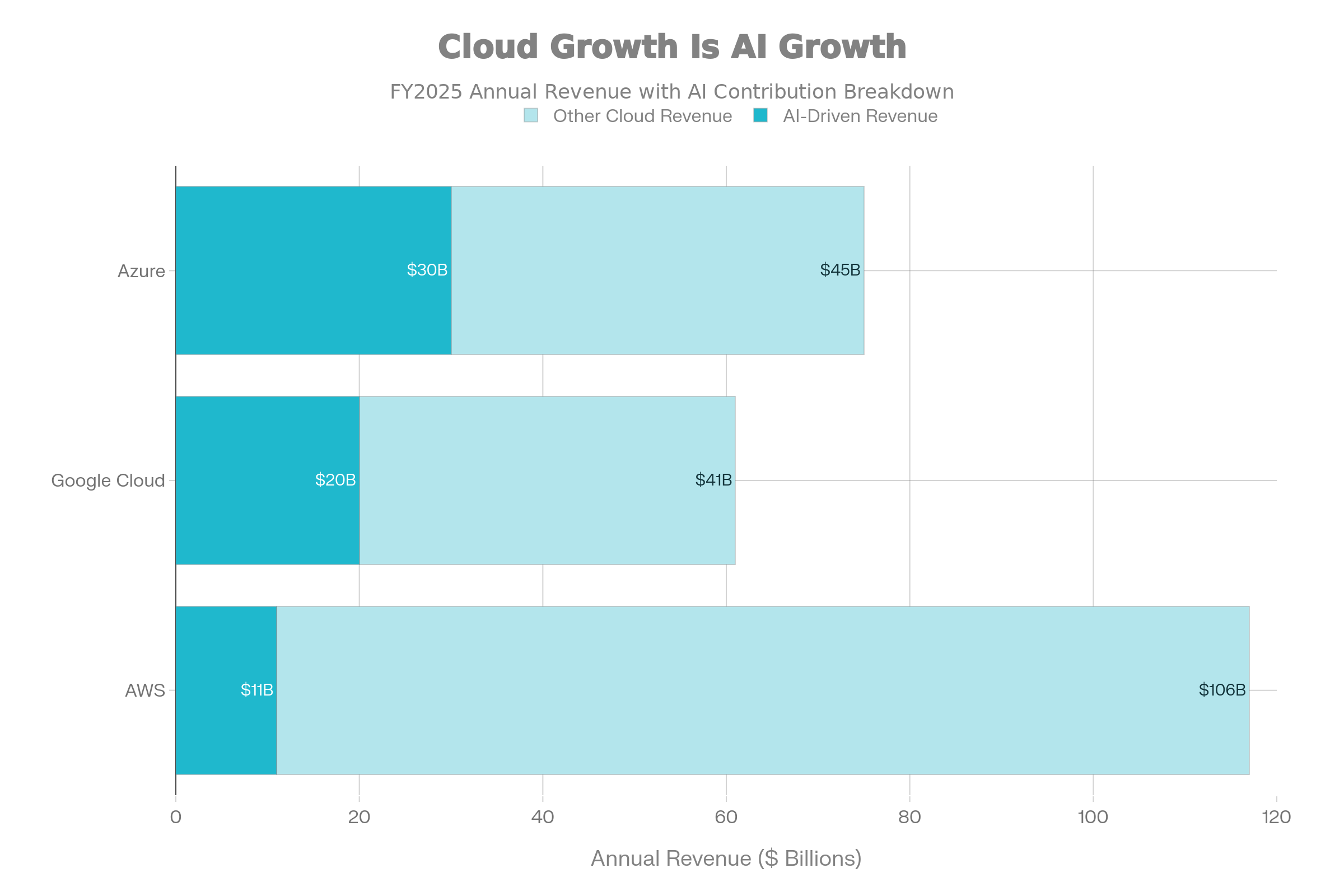
This is factually incorrect. When hyperscalers report cloud growth today, they are effectively reporting AI consumption. The scale of this revenue is already rivaling the peak of the SaaS boom, but it’s happening within the balance sheets of the giants.
Microsoft Azure: The platform grew 39% YoY in fiscal Q4 2025, reaching an annualized revenue run rate of over $75B. Crucially, Microsoft management disclosed that AI services contributed roughly 16 percentage points of that growth. In other words, AI is now driving more than 40% of Azure’s total expansion.
Google Cloud: Revenue surged 34% in Q3 2025, reaching a $61B ARR. This acceleration is being driven by the “Gemini stack,” with management confirming that 70% of their top customers are now using AI solutions.
AWS: On a massive base of $117B (trailing), AWS accelerated to 18% growth, adding roughly $18B in new annual revenue. What is unique here is the profitability: they maintained operating margins at approximately 40%. They are generating roughly $7B in new annual profit from the cloud alone, funding their own Capex.
The Invisible Revenue Stream
The mistake most analysts make is looking for a specific line item labeled “AI Sales” while missing the broader transformation. The tech giants are using generative AI to rewire their core cash cows, creating massive “invisible” revenue lift.
Meta (Advertising): Meta does not sell an LLM subscription, yet their ad revenue jumped 21% YoY. This was driven by their “Advantage+” suite, which uses generative AI to synthesize and test ad creative in real time. Advertisers using these tools are seeing conversion rates increase by 22%, effectively printing money for Meta’s core business.
Amazon (Retail): The new generative shopping assistant, Rufus, is not just a chatbot. Internal data suggests that customers who interact with Rufus have a 60% higher conversion rate than those who do not. This integration is on track to generate over $10B in incremental annualized sales by simply helping people find what they want faster.
Google (Search): Google’s AI Overviews are not cannibalizing search revenue as feared. Instead, search revenue grew 10% YoY to $50.7B following the AI Overview rollout. The company disclosed that AI features drive over 10% additional queries for the types of searches where they appear. With AI Overviews now reaching 2 billion monthly users, Google has turned the existential threat into a growth accelerator.
Microsoft (Productivity): Microsoft 365 Copilot is quietly becoming a revenue multiplier. The company now has over 70% of Fortune 500 companies using Copilot, and average revenue per user across the Microsoft 365 stack has climbed to $1,500 per year, driven largely by E5 and Copilot upsells. While Microsoft does not break out Copilot-specific revenue, analysts estimate it’s generating between $6B-$8B annually and growing rapidly as enterprises expand from pilots to full deployment.
Thanks for reading The Uncharted Algorithm! This post is public so feel free to share it.
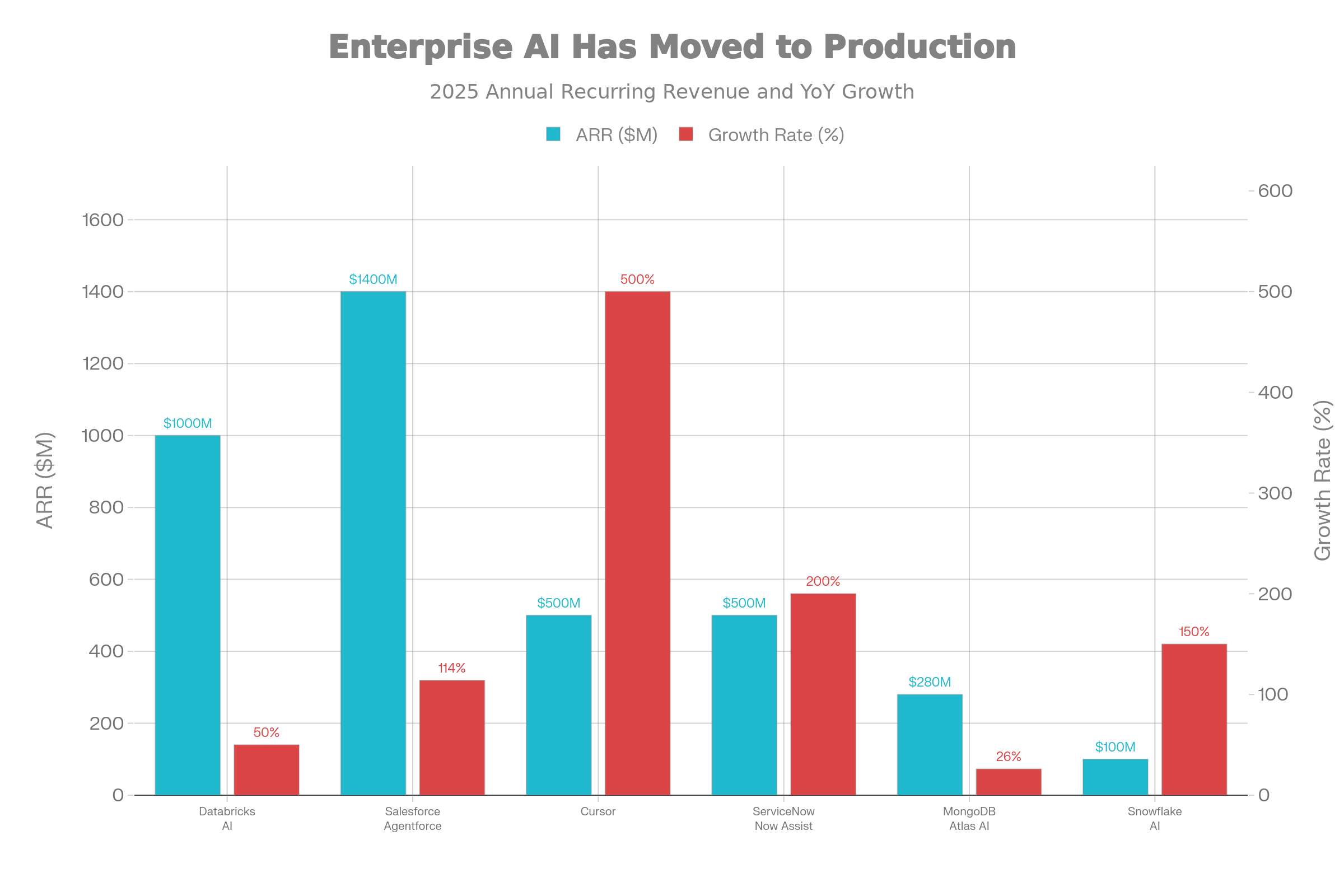
Beyond the “Mag 7,” the Q3 2025 data proves that AI has moved from the “innovation lab” to full-scale production deployment.
Databricks: Perhaps the clearest signal of enterprise AI spending is Databricks hitting $4B in annualized revenue, with AI products alone accounting for over $1B of that total. The company is growing over 50% YoY and maintains a net retention rate exceeding 140%, with over 650 customers each spending more than $1M annually. This is production-scale AI infrastructure spending, not pilots.
ServiceNow: As the workflow backbone for the Fortune 500, they are the cleanest proxy for enterprise adoption. Their “Now Assist” (GenAI) product is on track to exceed $500M in ACV this year. Consumption of their AI agents has increased 55x since May 2025.
Salesforce: The company’s Agentforce and Data Cloud AI platform reached $1.4B in ARR by Q3 fiscal 2026, growing 114% YoY. Since launching Agentforce in October 2024, Salesforce has closed 5,000 deals with 3,000 being paid contracts, not pilots. Six of their top 10 deals in the quarter were companies specifically buying to transform with AI agents.
This is how infrastructure cycles always resolve. Not with certainty, but with inevitability. The railroads were built. The electrical grid was wired. The internet scaled. And now, the AI operating system is being installed across every Fortune 500 company and embedded into every cloud workload.
MongoDB: The database provider’s Atlas cloud platform, which is rapidly becoming the go-to database for AI workloads, now represents 72% of total revenue and grew 26% YoY to reach approximately $395M in Q1 fiscal 2026. The company’s strategic acquisition of Voyage AI positions it to capture even more AI-native application workloads as enterprises build production systems.
Snowflake: The data cloud provider hit $100M in AI ARR a quarter ahead of plan, driven entirely by consumption workloads, not trials. CEO Sridhar Ramaswamy emphasized this was “real usage, not PowerPoint forecasts.” Customers are running production LLM workloads on Snowflake infrastructure and paying for it at scale.
UiPath: The automation platform beat expectations with revenue rising 16% to $411M and annual recurring revenue reaching $1.78B. The company’s pivot to agentic AI orchestration is accelerating, with customers like USI Insurance Services expecting $32M in savings over three years by deploying UiPath agents in production.
Adobe: While Adobe does not break out Firefly-specific revenue, generative credit consumption tripled in Q4 2025, and Creative Cloud revenue grew 11% to reach $4.25B. The company’s freemium AI tools now have over 70 million monthly active users, creating a massive funnel for premium AI feature upsells.
The AI Labs Confirm the Demand
The independent data from pure-play AI research labs confirms that this is a structural shift, not a consumer or enterprise fad.
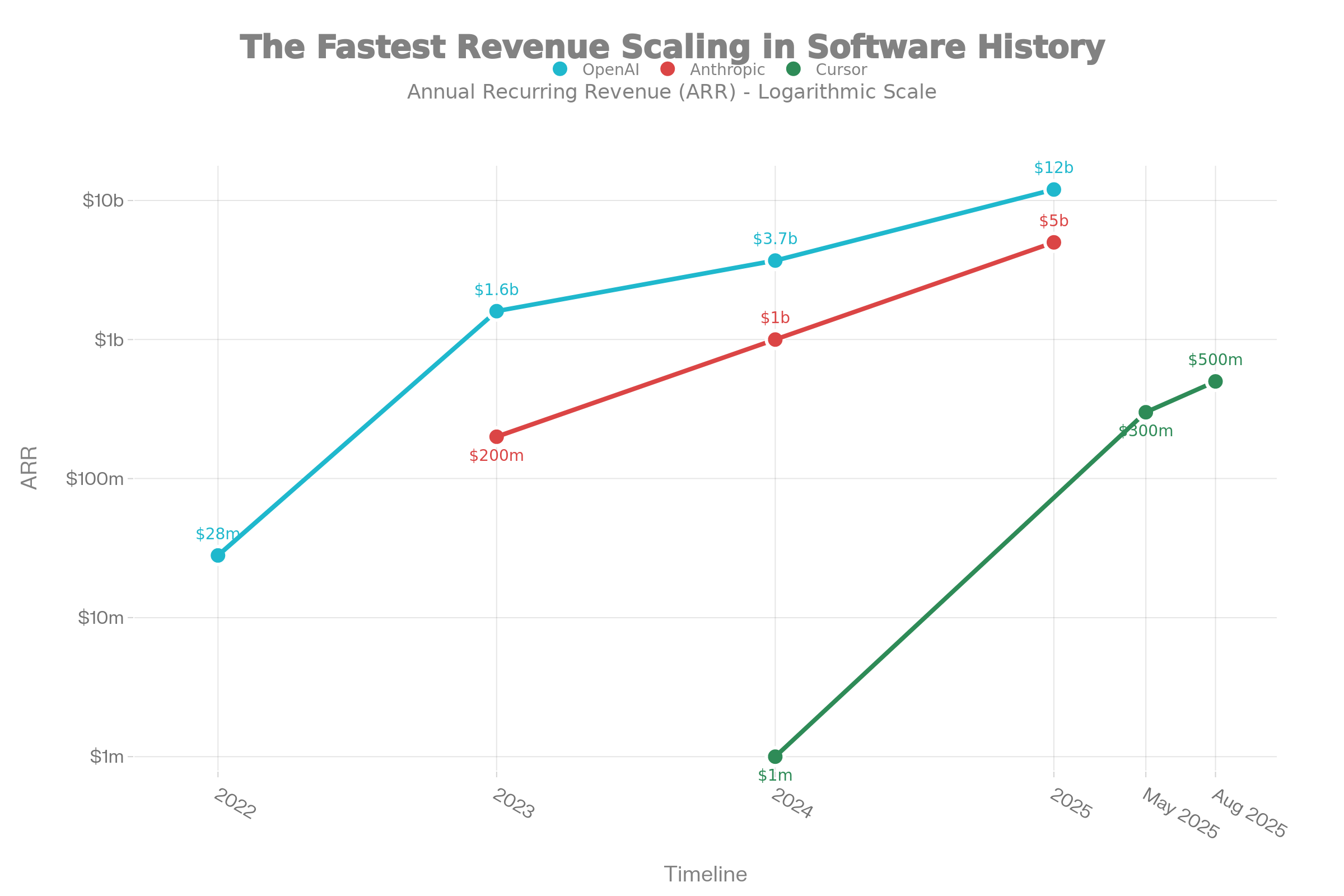
OpenAI: The company’s revenue soared from roughly $28M in 2021-2022 to surpassing $12B ARR by July 2025. This is the fastest growth to $10B in software history.
Anthropic: Revenue climbed from approximately $1B at the beginning of 2025 to a run-rate revenue of more than $5B by August 2025. Crucially, 80% of this revenue is enterprise. These are Fortune 500 workloads embedded into daily operations. Unlike consumer subscriptions, which can churn, enterprise infrastructure contracts are multi-year commitments.
Cursor: The AI-powered code editor reached $500M in ARR by May 2025, up from $300M just one month prior, making it the fastest-growing SaaS company of all time from $1M to $500M in ARR. Revenue is doubling approximately every two months. The company’s users include engineers at OpenAI, Shopify, Midjourney, and Perplexity, demonstrating adoption at the most technically sophisticated organizations. While GitHub Copilot generates over $300M in annual revenue, Cursor’s trajectory shows that developers are willing to pay for best-in-class AI coding assistance, and the market can support multiple winners in developer productivity tools.
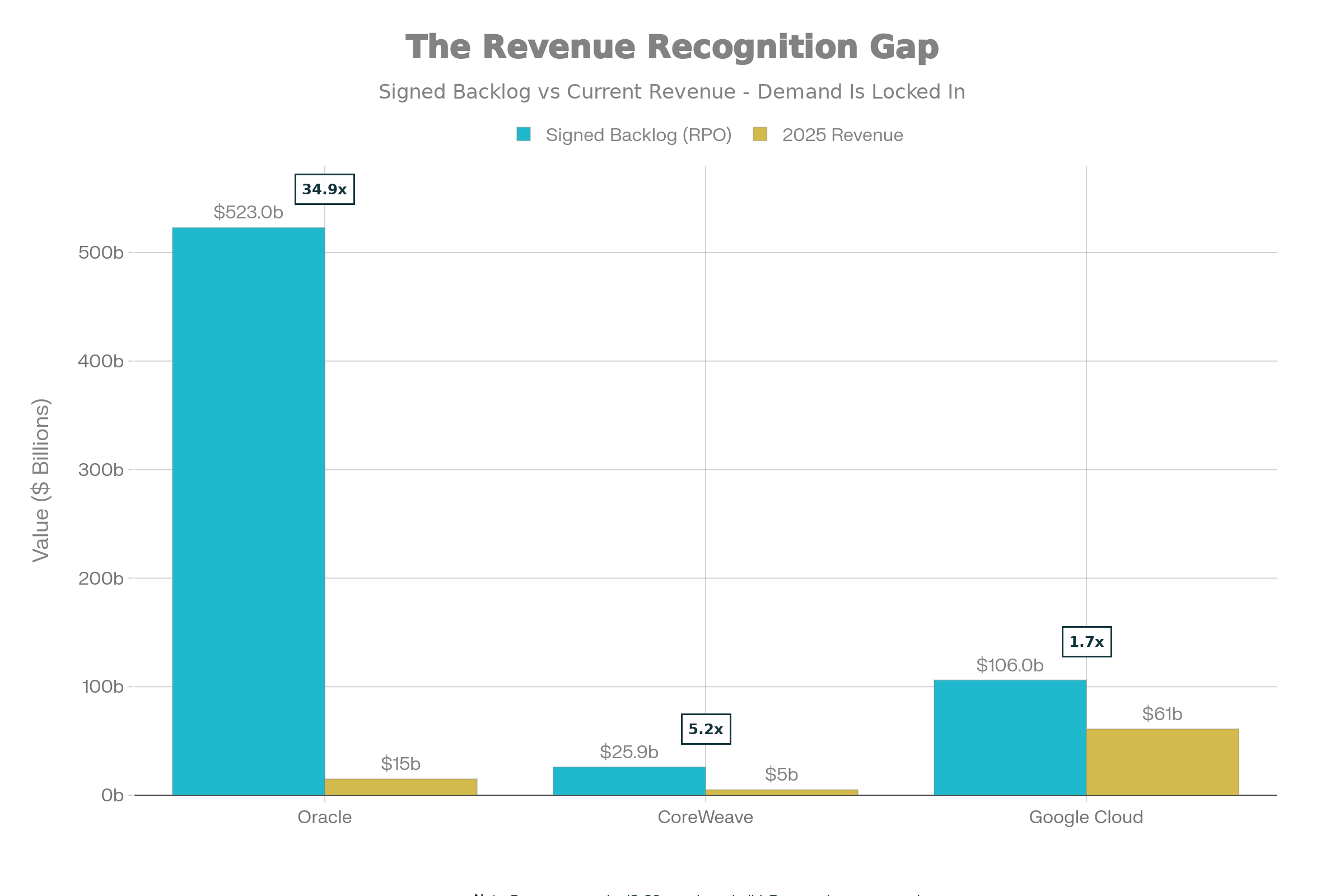
Oracle’s earnings this week sparked the panic, but the read was misguided. The issue is revenue recognition, not demand.
Oracle has billions in signed contracts (Remaining Performance Obligations, or RPO) that surged 438% YoY to $523B in Q2 fiscal 2026. The company added $68B in new commitments in the quarter alone, including major contracts with Meta and Nvidia. However, you cannot recognize cloud revenue until the datacenter is built, the GPUs are racked, and the keys are handed to the customer. Only 33% of Oracle’s RPO converts to revenue within 12 months, with the remaining 67% delayed for years as infrastructure is constructed. Oracle is building 72 multicloud datacenters to be embedded in Amazon, Google, and Microsoft clouds, plus over 211 regions worldwide. This is a build-out story, not a demand story.
CoreWeave tells the same story from a different angle The specialized GPU cloud provider grew revenue 420% YoY to nearly $1B in Q1 2025. Critics worry about “shaky tenants” in the neo-cloud space - smaller AI startups that might default on their bills. But CoreWeave’s $25.9B backlog is anchored by the strongest balance sheets in the world, not startups. It includes a $14.2B deal with Meta and a $6.3B agreement with Nvidia. This is not speculative vendor financing. Its infrastructure is rented by the S&P 500’s most profitable companies. The bottleneck is not tenant creditworthiness, but the physical buildout. CoreWeave is deploying over $20B in capex in 2025 just to execute the contracts it has already signed.
In 2000, the build-out was funded by speculative debt and VC cash. Today, it’s funded by the free cash flow of the most profitable companies in history.
This Is Not 2000
I hear the comparisons to the dot-com bubble constantly, but the mechanics are inverted.
Funding: In 2000, the build-out was funded by speculative debt and VC cash. Today, it’s funded by the free cash flow of the most profitable companies in history. The hyperscale cloud providers alone generate $209B in trailing twelve-month free cash flow, easily absorbing the capex.
Furthermore, the market is enforcing discipline before a bubble can inflate. Insurers like AXA are publicly warning against speculative datacenter builds, and credit markets are tightening standards for weaker tenants. This capital bifurcation creates a safeguard where cheap money flows to Microsoft while expensive money squeezes speculators. This prevents the kind of low-quality supply glut that crashed the market in 2001.
Utility: We are not counting “eyeballs.” We are counting contracted revenue and measurable economic output. U.S. labor productivity jumped 3.3% annualized in Q2 2025, significantly outpacing historical averages. This isn’t just a statistical quirk. It coincides perfectly with the mass deployment of enterprise AI tools, from Klarna replacing 700 agents to ServiceNow seeing 55x growth in AI agent usage. The “operating system upgrade” is already driving measurable GDP impact.
Constraints: The energy and land requirements are real, but these constraints are being solved in parallel. Oracle alone has secured building permits for three small modular reactors to power a gigawatt-scale datacenter. Paradoxically, these supply chain constraints act as a governor on the market. Transformer lead times stretching to 140 weeks prevent the overbuilding that characterized the fiber bubble.
The Long View
I expect the debate will rage through 1H 2026. The infrastructure spend is real, the contracts are signed, and the revenue is already flowing. The only question is whether impatient capital can wait for the concrete to dry and the transformers to energize the datacenters.
The Timing Question
As demonstrated in Oracle’s $523B RPO and CoreWeave’s $25.9B backlog, the demand is locked in. The challenge is that datacenters take 18-30 months from groundbreaking to commissioning, with hyperscale AI facilities often stretching to 24 to 36 months in power-constrained regions. The capex surge began in earnest in mid-2024, which means the first wave of capacity becomes revenue-generating infrastructure between Q4 2025 and Q2 2026. The second, larger wave hits in the second half of 2026 and into 2027.
AISIGINT is an audit and governance platform for AI datacenter investments, providing a managed “ground truth” verification layer across power, fiber, permits, and project delivery so capital doesn’t get stranded in sites that can’t be built.
While the market obsesses over quarterly cloud growth rates, it’s missing the capability shift happening right now. As of December 2025, we are not speculating about future agent capabilities. We are measuring production deployments.
The Reinforcement Learning “Gyms” Under the surface, a new infrastructure layer is forming to bridge the gap between pilot and production: Reinforcement Learning (RL) “gyms.”
Platforms like Mercor, Scale AI, and Turing are building domain-specific environments that replicate complex enterprise systems like Salesforce, Zendesk, SAP etc. inside controlled sandboxes. Instead of “game play,” these gyms let agents practice multi-step workflows like lead qualification, support resolution, and financial reconciliation millions of times before they ever touch production data. Scale AI’s research demonstrates that agents trained in these specialized RL loops significantly outperform general-purpose models on accuracy and reliability.
At the same time, multi-agent orchestration is moving from theory to deployment. Hyperscalers and independent platforms are wiring these gym-trained agents together into end-to-end automation swarms. Early case studies report 50-70% reductions in cycle times when coordinated agent teams take over routine workflows across HR, logistics, and contract management.
This is the industrialization of reasoning turning probabilistic models into deterministic business outcomes.
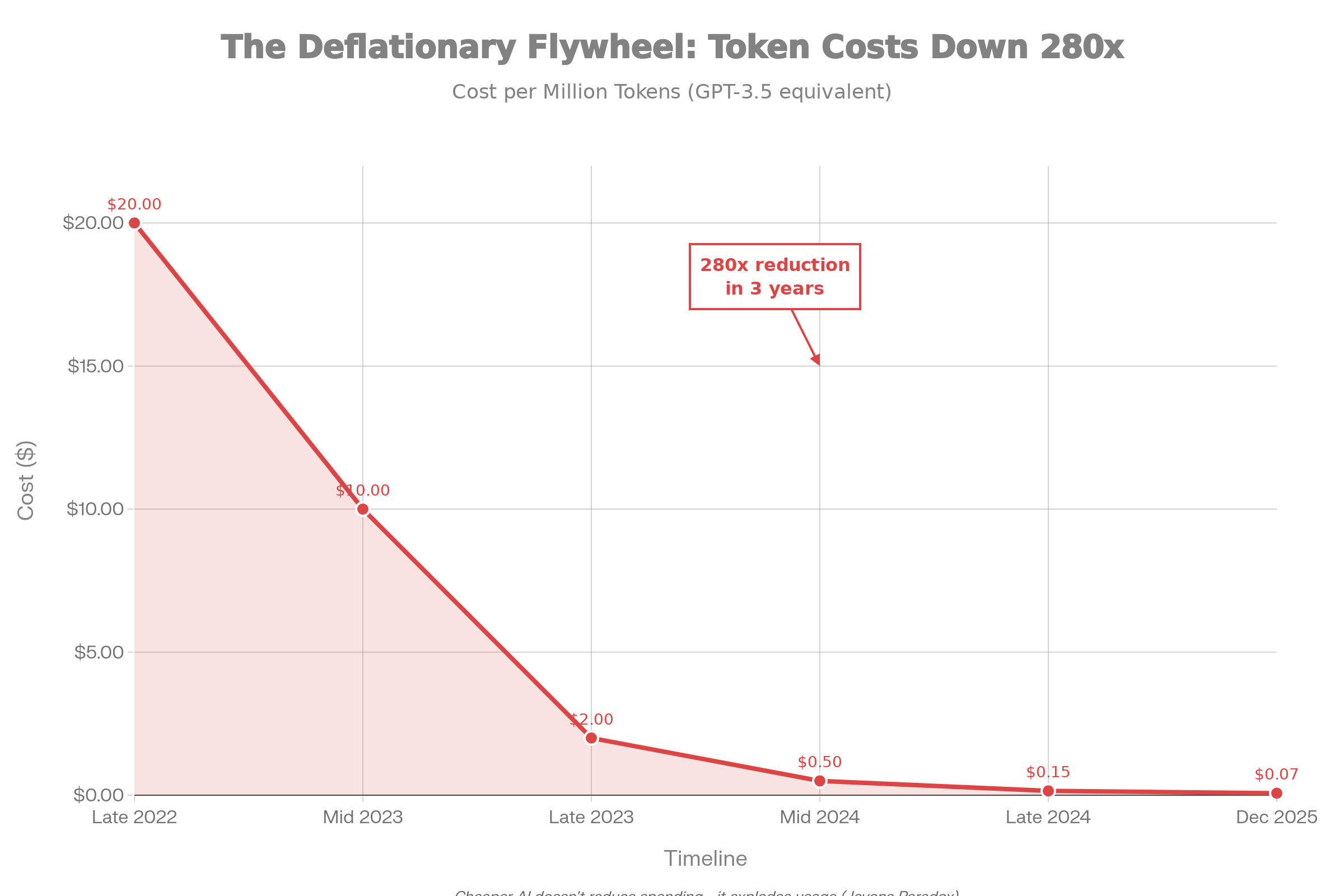
This is the Jevons Paradox in action showing that cheaper AI does not reduce spending, it accelerates usage. Tasks that were economically marginal in 2024 are production-critical today.
This is not a bubble bursting. It’s impatient capital leaving before the revenue catches up to the spend.
How This Plays Out
The market will force a decision point by 2H 2026. Either the revenue growth materializes as infrastructure comes online, or impatient capital exits before the construction cycle completes. The probabilities are asymmetric i.e in the favor of the AI buildout because the underlying demand is already proven.
Base Case: The Trough Fills In (60% probability)
Revenue recognition accelerates through 2H 2026 as 2024-2025 capex converts to operational infrastructure. Cloud growth rates stabilize at 20-25%, enterprise AI adoption metrics continue climbing (ServiceNow, Salesforce, Databricks all show accelerating usage), and the RPO backlogs at Oracle and CoreWeave begin converting to reported revenue.
Agentic workflows move from pilot to production at Fortune 500’s, driven by the convergence of reasoning models from the top AI labs. The bears who exited during the Q1-Q2 2026 volatility miss the re-acceleration. Market multiple compression reverses as the revenue/capex ratio normalizes and autonomous agents shift from “co-pilot mode” requiring constant user input to genuine task automation across domains trained through specialized RL gyms.
Bear Case: The Execution Trap (15% probability) The infrastructure hits a “digestion” phase. It’s not just about concrete drying; it’s about the supply chain and credit markets choking on the volume. Lead times for transformers have stretched to 140 weeks, and rising memory prices (DRAM/NAND) compress margins for hardware deployers. Simultaneously, the “neo-cloud” market fragments as private credit lenders tighten standards, forcing a washout of smaller GPU renters who can’t pay their bills.
This delays revenue recognition into 2027 and causes a temporary dip in utilization rates for non-hyperscalers. Markets lose patience, and multiples compress. But notice what doesn’t happen: the Hyperscalers (Meta, AWS, Google, Microsoft) don’t stop. They use their fortress balance sheets to capture market share while the smaller players wash out, ultimately consolidating the industry even further.
Bull Case: The Flywheel Accelerates (25% probability)
Revenue uplifts arrive faster and larger than anticipated because the capability shift is steeper than the market expects. The combination of production-ready reasoning models from five competing labs, domain-specific RL training, and enterprise-grade governance platforms enables genuine software automation by mid-2026. Developers using Cursor and similar tools see 3x to 5x productivity gains. Enterprises deploy autonomous agents that handle end-to-end processes (procurement, customer service, financial analysis) with minimal human oversight. Meta’s ad ROAS improvements, Microsoft’s 365 Copilot adoption, and AWS AI services revenue all exceed guidance by Q2 2026.
Critically, volume growth outpaces price deflation by a wide margin. The 280x cost reduction since 2022 expands the addressable market so dramatically that total spend accelerates despite falling unit costs. This triggers a second wave of enterprise AI adoption from laggards who were waiting for proof. Capex doesn’t decline in 2027 but instead grows another 20 to 30% as hyperscalers race to capture market share in what is now clearly a winner-take-most infrastructure cycle, with estimates climbing toward $650B-$700B for 2027. The reinforcement learning gyms return as companies build custom agents for industry-specific workflows, creating a new software category worth tens of billions annually.
The current uncertainty is about the cross-over point between infrastructure availability and revenue recognition, not about the validity of the underlying cycle.
The Signal Will Emerge
By Q3 2026, the construction timelines guarantee that enough infrastructure will be operational to generate decisive data. The question is not whether capabilities exist (they already do) or whether demand is real (the contracts are signed).
The question is whether revenue growth arrives in Q2 2026 or Q4 2026, and whether the market has the patience to wait for the answer.
This is how infrastructure cycles always resolve. Not with certainty, but with inevitability. The railroads were built. The electrical grid was wired. The internet scaled. And now, the AI operating system is being installed across every Fortune 500 company and embedded into every cloud workload.
The current uncertainty is about the cross-over point between infrastructure availability and revenue recognition, not about the validity of the underlying cycle.
The ones who wanted to de-risk will have already left by summer 2026. What remains will be the investors who understand that the gap between writing the check and opening the datacenter doors is not risk, but opportunity.